
Individual first-line detection, marking and demining kit
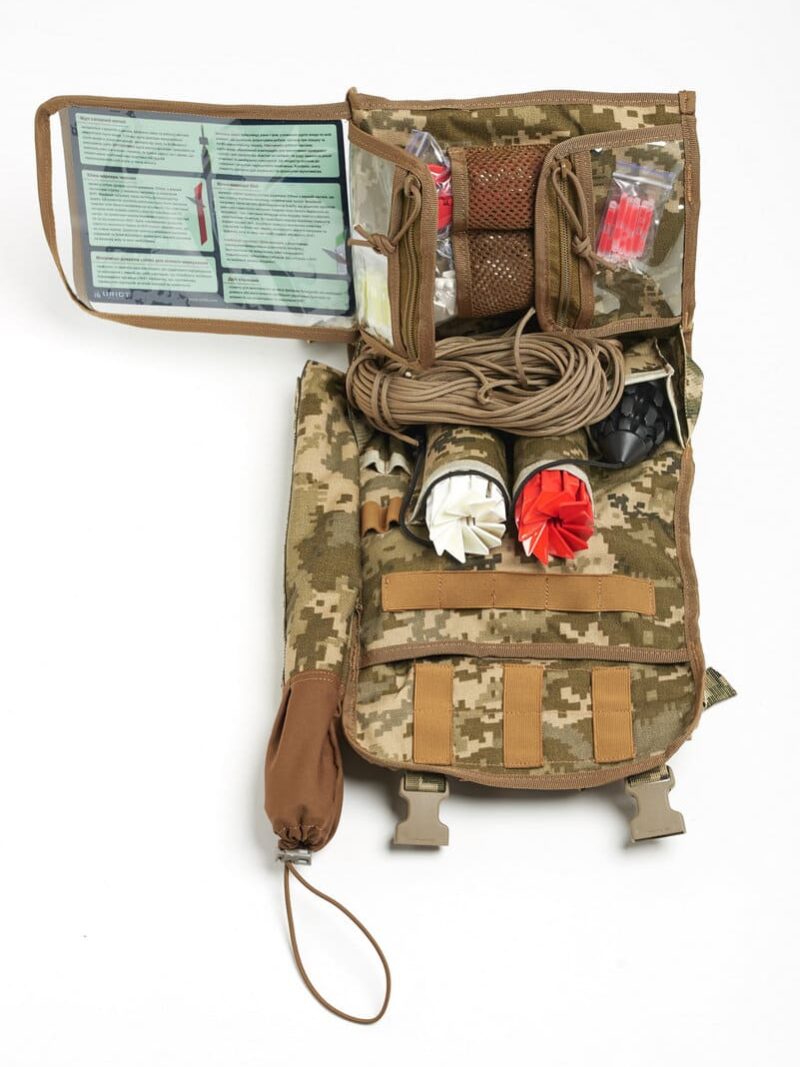
Individual first-line detection, marking and demining kit
Each kit contains:
- Compact non-magnetic demining probe – 1 pc.
- Tripwire and break-wire activation device – 1 pc.
- Paracord – 30 m.
- Demining pins: 80 mm – 10 pcs., 40 mm – 20 pcs.
- Red marker stakes – 10 pcs.
- White marker stakes – 20 pcs.
- White safe-direction indicators – 30 pcs.
- Red danger-direction indicators – 30 pcs.
- Green miniature chemical lights – 10 pcs.
- Red miniature chemical lights – 10 pcs.
- Steel wire – 1 m.
- Dedicated storage and transport bag – 1 pc.
Description
Video review of the first-line demining kit
First-line demining kit features and description
This kit is intended for military personnel and emergency-service specialists who perform mine-clearance work and create passages through minefields.
The compact demining probe consists of a handle with a collet, a clamping nut and a non-magnetic working probe. Probes made from different materials can be used depending on conditions. Its ergonomics support kneeling and prone work with one or both hands. The collet holds the probe evenly, allows its length to be shortened and the search depth to be calibrated. The tip is coated with an insulating compound for protection against electrical booby traps; the coating should be inspected visually and with a multimeter.
The tripwire activation device is assembled from reinforced engineering polymer. Its shape passes through grass, branches and shrubs with fewer snags, while calibrated slots reliably catch nylon cord, fishing line, steel wire, break-wire sensors and command lines. The device may be launched from a rifle-mounted mortar or line thrower to a distance of up to 120 metres, allowing the operator to work from cover. The emergency-service version includes design features that prevent use with hand grenades. A highly abrasion-resistant shock-leader cord is attached to the device.
Red marker stakes indicate the direction of a detected explosive object, while white stakes indicate a safe passage. Their fluorescent paint remains clearly visible after dark and can be seen from at least ten metres when illuminated. Additional red and white direction flags identify dangerous, unexamined and safe areas.
The combination of red and white markers and direction flags provides clear, unambiguous information about explosive hazards within the marked area.
Red and green miniature chemical lights provide additional night-time marking, including concealed movement and night evacuation. Steel wire is used on site to manufacture locking pins and other auxiliary mine-clearance and marking components.